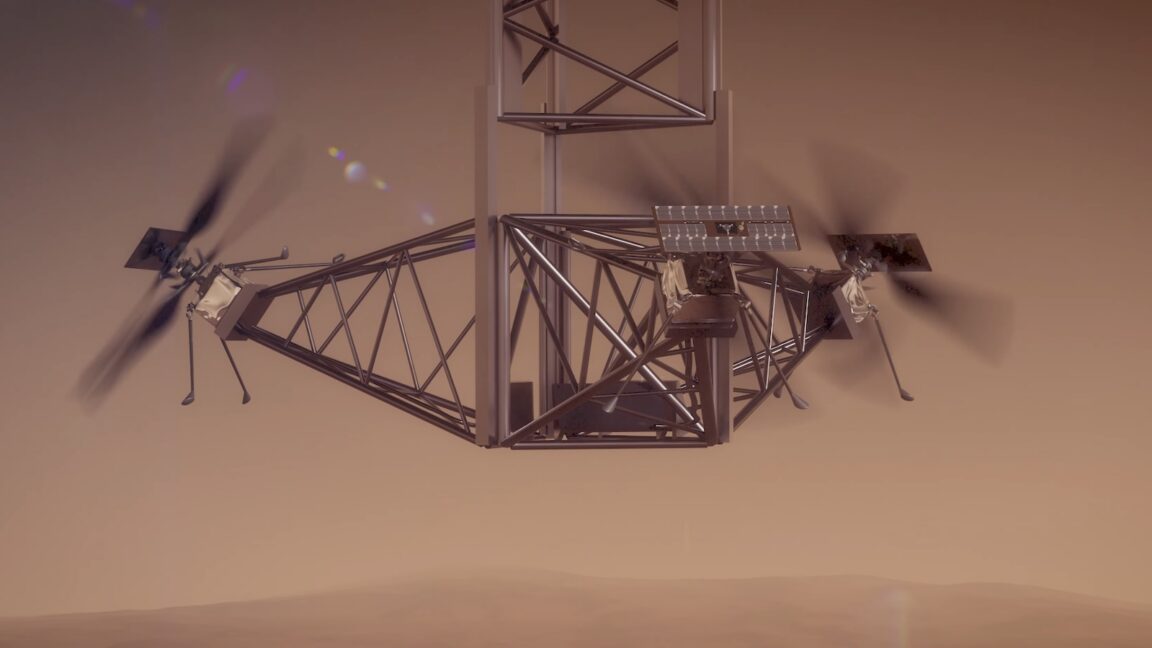
Engineers at NASA's Jet Propulsion Lab make a breakthrough in rotor technology
Ars Technica • • science
Key Points:
- NASA engineers at the Jet Propulsion Laboratory are developing next-generation Martian helicopters capable of carrying heavier payloads and flying longer distances in Mars’ thin atmosphere, building on the success of the Ingenuity helicopter which completed 72 flights.
- The upcoming SkyFall mission, potentially launching as early as 2028, will deploy three larger and heavier helicopters that use innovative landing techniques and communicate directly with Earth or orbiters, unlike Ingenuity which relied on the Perseverance rover.
- Recent tests demonstrated that rotor blades can safely exceed the speed of sound (Mach 1.08) in simulated Martian conditions, increasing lift capacity by 30%, a critical breakthrough for supporting heavier scientific instruments and longer flights.
- The rotor tests involved both three-bladed designs for future missions and the actual two-bladed design for SkyFall, confirming enhanced performance without rotor damage, enabling more ambitious aerial exploration of Mars.
- NASA is also working on Dragonfly, a much larger rotorcraft for Saturn’s moon Titan, which benefits from a denser atmosphere, while future Mars helicopters aim to carry advanced sensors and larger batteries to expand scientific capabilities.


