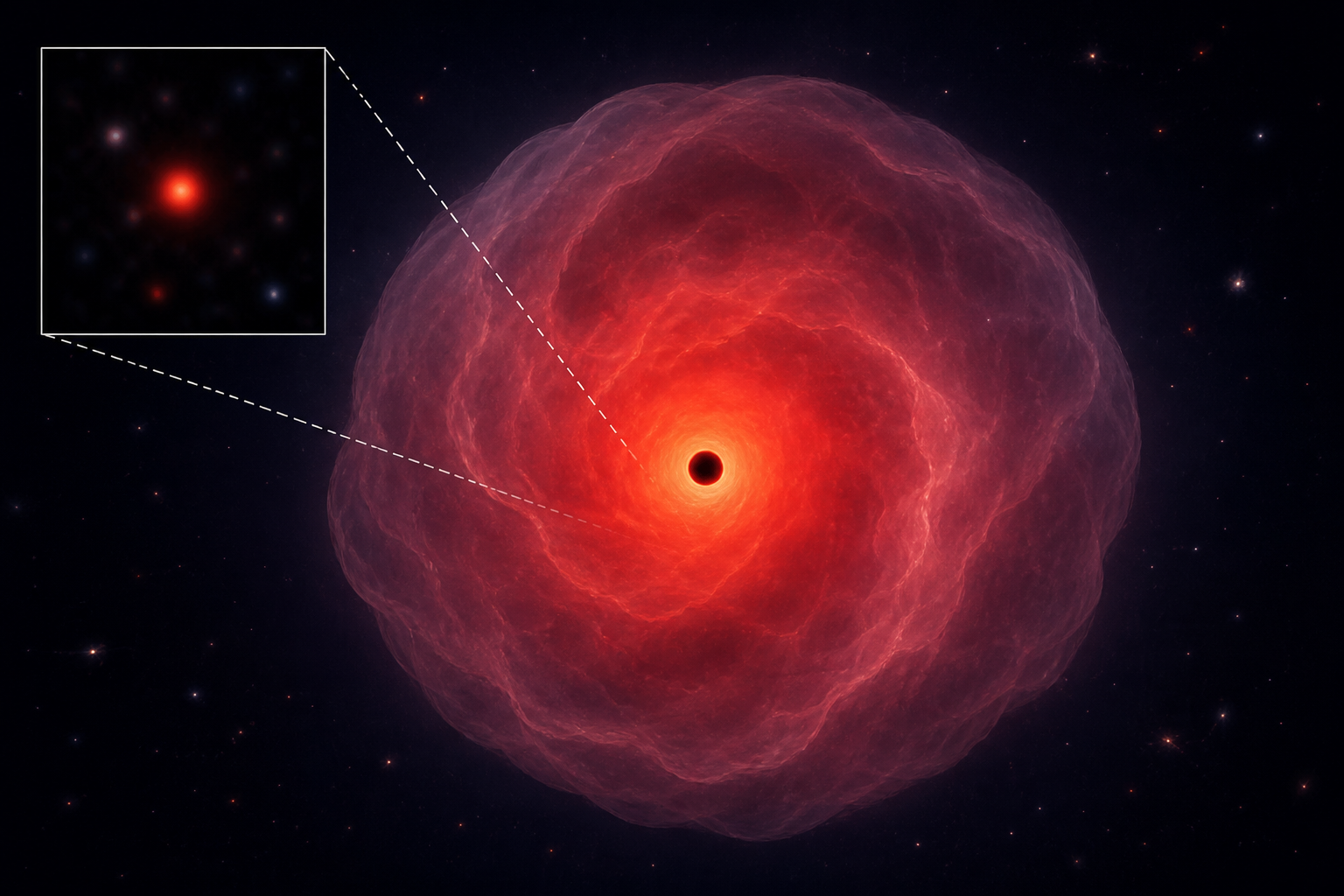
AI Generated Image
For years, mysterious little red dots kept appearing in James Webb images of the early universe — astronomers now think one is a “black hole star,” a growing black hole hidden inside a star-like gas c
Space Daily • • science
Key Points:
- Shortly after the James Webb Space Telescope began operations in 2022, astronomers observed numerous tiny, intensely red points in deep space images, dubbed "little red dots," which defied existing explanations as galaxies or black holes.
- A detailed study led by Rohan Naidu identified one such object, MoM-BH*-1, as a massive black hole about 100,000 times the sun's mass, enveloped in dense hydrogen gas that glows like a giant star, outshining the brightest known stars by 100 billion times.
- The object's spectrum showed an extreme Balmer break and a lack of heavy elements, challenging the usual dust explanation for red coloration and suggesting a new type of black hole-star hybrid.
- Additional studies, including observations of similar dots and spectral analyses, support the black hole surrounded by glowing gas model, though key questions about the formation and stability of the gas envelope remain unanswered.
- Researchers propose that these enigmatic objects could influence the rate of star formation in early galaxies, potentially affecting the evolution of the cosmos, with further observations planned to clarify their nature.


