Satellite imagery reveals increasing volatility in human night-time activity
Nature • • science
Key Points:
- This study uses NASA's Black Marble VIIRS DNB sensor data from 2013 to 2023 to analyze global artificial light at night (ALAN) changes, focusing on terrestrial regions between 70°N and 60°S, excluding polar areas and water bodies.
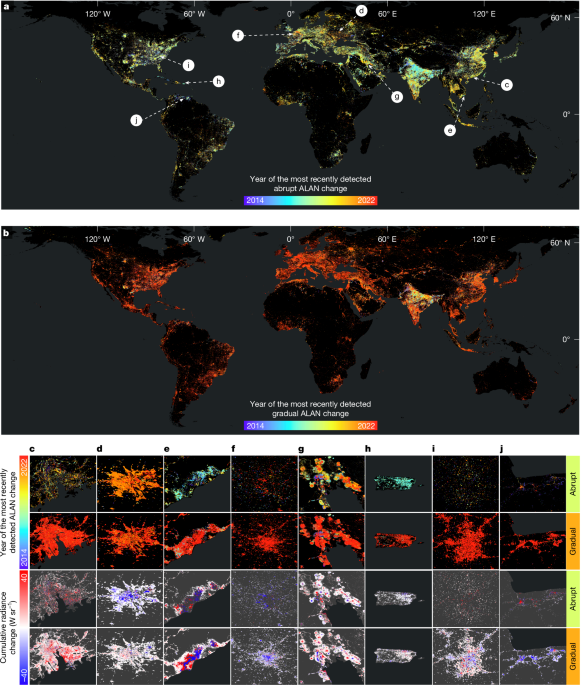
- ALAN changes are classified as abrupt (short-term, event-driven) or gradual (long-term trends), with each change further categorized by direction as brightening or dimming, based on statistically significant radiance variations.
- The VZA-COLD algorithm stratifies data by sensor viewing angles to detect ALAN changes, applying thresholds to ensure changes are significant and persistent, and deriving metrics like change time, area, intensity, and radiance change for spatial and temporal analysis.
- Accuracy assessments employed stratified random sampling and expert visual interpretation to validate change detections, yielding unbiased accuracy estimates and enabling correction of mapped area estimates for classification errors.
- Spatial analyses aggregated pixel-level data into latitude/longitude grids and administrative boundaries, while temporal trends in ALAN change from 2014–2022 were evaluated using non-parametric regression methods to identify significant global and regional patterns.


