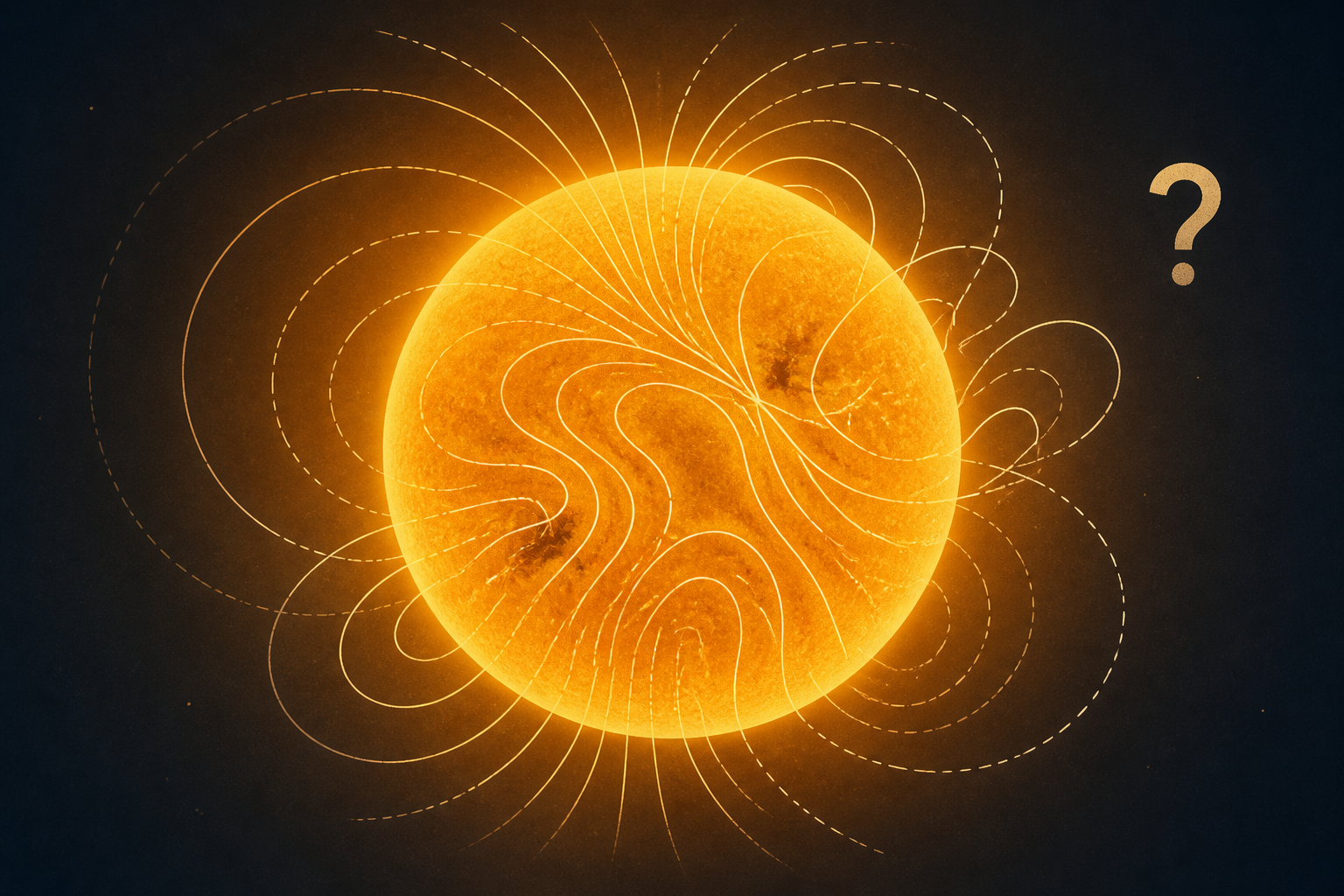
AI Generated Image
The Sun’s Magnetic Field is Behaving Oddly. Astronomers Still Don’t Know Why.
Yahoo • • science
Key Points:
- In 2007, astronomer Erika Böhm-Vitense observed that the sun's magnetic activity and spin rate did not fit into the two known groups of stars, sparking a two-decade investigation into the sun's unusual behavior and its implications for life on Earth.
- Recent research suggests that stars like the sun undergo a "magnetic crisis" in middle age, where their large-scale magnetic fields weaken significantly, challenging earlier models like gyrochronology that linked star age directly to spin rate.
- Studies indicate that the sun’s dynamo—the mechanism generating its magnetic field—is slowly collapsing, which could mean calmer space weather in the coming billions of years; however, alternative theories propose that the magnetic field may revive through complex shape changes.
- Understanding stellar magnetic evolution is crucial for assessing planetary habitability, as magnetic activity affects space weather and atmospheric retention on orbiting planets, influencing the search for life beyond Earth with upcoming missions like NASA’s Habitable Worlds Observatory.
- While progress has been made in modeling stellar spin and magnetism, astronomers acknowledge significant gaps remain in understanding these processes, which are essential for interpreting the sun’s role among stars and guiding future exoplanet exploration.


![Google Pixel screen savers add new styles, swipe gesture [Gallery]](https://media-cdn.cashwalklabs.io/https%3A%2F%2Fs3.us-west-2.amazonaws.com%2Fimages.cashwalklabs.io%2F0_admin%2Fnews-ai-images%2F01a020c8-02ff-7739-94ec-8cdc8c008429.webp?format=webp&w=120&h=80)


