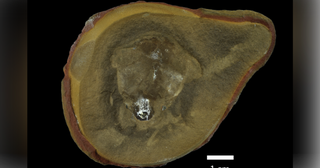
"Weird blob" creature thought to be the world's oldest octopus isn't an octopus after all. Here's what scientists found.
CBS News • • science
Key Points:
- A fossil previously identified as the world's oldest octopus, Pohlsepia mazonensis, has been reclassified as a relative of the nautilus, a shelled cephalopod, based on new research by Thomas Clements and his team at the University of Reading.
- Using advanced synchrotron imaging, researchers discovered the fossil's radula contained 11 teeth per row, a characteristic inconsistent with octopuses, which have seven or nine teeth, confirming it is not an octopus.
- The fossil, found in Illinois' Mazon Creek fossil-rich area, had been controversial since its 2000 identification, which suggested octopuses evolved much earlier than previously thought; the reclassification closes a significant evolutionary gap.
- Guinness World Records has removed Pohlsepia mazonensis from its listing as the earliest known octopus fossil following the new findings, with the Field Museum in Chicago, where the fossil is held, now possessing the oldest known soft tissue nautilus specimen.
- Researchers emphasize the importance of reexamining fossils with modern technology, which can lead to significant revisions in scientific understanding and exciting discoveries.


